Prikaz objav z oznako Slovenija. Pokaži vse objave

sreda, 17. avgust 2016

Degradation of archaeological sites because of archaeological research - example hillfort Ajdovščina/Rodik/Slovenia

Usually there is a degradation of archaeological sites due to natural disasters, changes in vegetation cover, intensive agricultural use, various land and building works and treasure hunters.

Usually
we archaeologists do not admit that even our work has degrading effects on archaeological sites. But at this point I do not mean archaeological excavations in the so-called rescue archaeology. Rescue excavations and archaeological research is usually done because of construction work in the area of archaeological site and it is only way to save it.

Here I write about archaeological excavations and research, that is done on exclusively research and study basis. I will present one case where archaeologist left archaeological site in "disarray" and neglected. It is meant on one hand as critique of management of excavators and on the other hand a reminder to our-self. In what state do we leave archaeological site behind.

One example of poor management is the condition of the archaeological site Ajdovščina, that I wrote about previous month. Archaeological research was conducted in the 80s and 90s by the Department of Archaeology Faculty of Arts in Ljubljana, Slovenia.

Situation
already shocked me few years ago when I visited the site for the first time, and disappointed and angry by the condition of some archaeological features. When I visited it this year I decided that because nothing had changed and on some parts situation is getting worse I have to write something down and also inform Department of archaeology of the unfinished business they left up there.

What follows are photos of degraded and neglected areas left by archaeological research.
Poles that marked grid for geophysical survey. As they are made from wood they do not represent an environmental problem. More a visual garbage and it looks as someone will build something up there.
The section of the main bank. Because left open it has started to slide and fill by natural destruction of still standing bank. The section also degrades the whole view of the majestic ruins of the main wall around the main entrance to hillfort.
Section made through the ruins of main wall. Sliding of material is seen on bout edges.
Spoil heap of material from ruins of main wall, that is left on the bank.
Shed for tools left standing on the top of the hill.

PVC foil left laying around. Started to tear and pollute whole site.
PVC foil left laying around. Started to tear and pollute whole site. Spoil heap of main excavation on left.
Spoil heap of main trench on the top of the hill.
PVC foil left on the excavated late antiquity foundations. Started to tear as trench wasn't properly filed back. Foundations started to crumble.

Teared PVC foil now seen almost on half of the whole site.
This image of the archaeological site of the so-called "research" excavations is inadmissible. Similar is the surroundings of cave site of Mala Triglavca near Divača, especially plastics and PVC that are lying around. I urge the Department of Archaeology, to activate and clear all PVC at least.

For me personally such an attitude indicates a stance and that archaeological sites are only information carrier. We need only to dig them and then, take away all the data to study it in the comforts of our chair. Who gives a s*** about what we left when we dug it.

Archaeological sites are the living remnants and witnesses of life of ancestors.
Archaeological sites are vital part of any landscape. Every archaeologist would have to take care and respect the environment and archeological sites and leave minimal impact on them.

We musnt let this bad examples to message to public: Archaeologists were here and we don give a f***for the environment and archeological site itself..

četrtek, 16. junij 2016

Hillfort Ajdovščina - Giant of Brkini hills

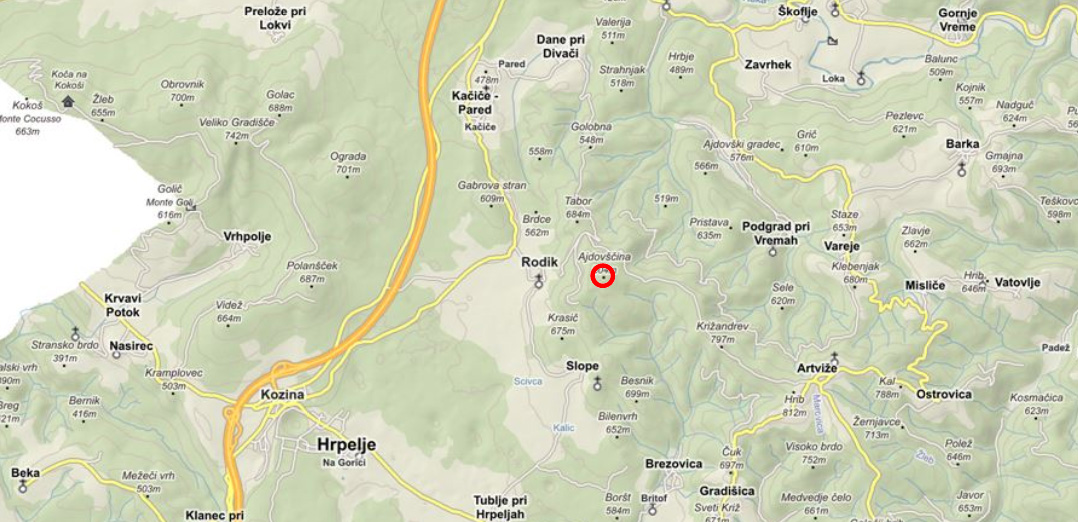
Ajdovščina is a 804m high hill that lies above the village Rodik in the Hrpelje-Kozina municipality. It is an end of the central Brkini ridge of the northern part of Brkini. Hill Ajdovščina has a very exposed and dominant position in the landscape. From it you can see far to Karst region, Vremščica hill, on the crest of Slavnik ridge and the Gulf of Trieste.


Location of hill Ajdovščina on a map (geoprostor.net)
The name of the hill Ajdovščina is interesting. It is derived from the word or name Ajd. Ajdi within the folk tradition usually describe giants or non-Christians. Word came in the Slovenian language from the Middle High German, who has origin in the Germanic base that is derived from the Greek "tàéthnē". In Germanic tales the name of Ajd within the folk tradition and place names have the same meaning as in Slovenian.

In archeology everything connected with Ajdi (placenames, folk traditions) are very important as an indicator of possible archaeological sites. To these giants folk tradition usually attribute origin or construction of larger visible and large structures in landscape, whether human made (hillforts) or natural (rocky walls).

In folk tradition Ajdi
are referenced to the people who were "here" in the landscape before new settlers (Slavs) who are the carriers of giants Ajdi folk tradition.

On the hill Ajdovščina are still visible remains of massive walls, with gates and ruins the walls of individual houses. In the 80s and 90s the hillfort Ajdovščina was investigated by the Department of Archaeology of the Faculty of Arts in Ljubljana. They have conducted some surveys, small scale excavations and geophysical surveys.

Entrance to the hillfort Ajdovščina. On left and right are clearly visible the remains of Late Antiquity wall (photo: Jošt Hobič). 
LiDAR picture of hillfort Ajdovščina. Most of visible archaeological features are from Late Antiquity (author: Jošt Hobič).

Oldest evidence of settlement on Ajdovščina is from early Iron Age (7th century BC). During excavation inside hillfort Ajdovščina they found fragments of pottery and cremation urn grave near road that leads to hillfort from early Iron age. Settlement of hillfort is likely to continue to the Roman period. For now we have evidence that hillfort was still occupied from 1st century BC to the 2nd century AD. Archaeologist found Roman pottery at the top area of hillfort. They were situated under a floor of late antique apse building. Outside the settlements they have discovered two cemetery’s where they excavated 19 graves all dated to Antiquity. After this period settlement is abandoned and possibly inhabitants relocate to of the valley.

One of the visible ruins of Late Antiquity house (photo: Jošt Hobič).
Same house remains with lines of walls drawn (photo: Jošt Hobič).
LiDAR map with location of house. Click to see it better (author: Jošt Hobič).
The hillfort Ajdovščina again comes to life in the turbulent times of Late Antiquity of 4th and 5th century AD. All ruins of drystone walls within the settlements and the wall around settlement, which can still be seen on the surface are from this period.

During
Late Antiquity they strengthen the walls and gates and set the houses that are aligned in a street system and along the wall.
 

At the top of the hill during the excavations archaeologist found a building with an apse. Such a semicircular completion of the building, usually in Late Antiquity hillfort settlements indicates the early Christian church. But here on the basis of the findings such church could not be confirmed yet.

In
Late Antiquity, Ajdovščina, due to the dominant position and close proximity to the Roman state road Aquileia - Tharsatica running through Matarsko valley, acted as control of these road connections to Italy. Therefore we can expect it had permanent military garrison.

For the period of the
Early Middle Ages (from 7th to 9th century AD) and Slavic settlement Ajdovščina was one of the centers in the surrounding area of Romanized indigenous people who still lived here. Despite the absence of archaeological finds, this is assumed on the basis of the interpretative model of the folk tradition and some historical writen evidences.


Literature
Hrobat, K. 2003, Šembilja na rimskih cestah. O ustnem izročilu in arheoloških raziskavah, diplomsko delo, oddelek za arheologijo FF, Ljubljana.

Pavlin, P. 2014, Ajdovščina nad Rodikom, v: Kras in Brkini za radovedneže in ljubitelje, ur. Fakin Bajec J. In Luthar O., ZRC SAZU, Ljubljan – Nova Gorica.

Mušič, B. 1999, Geophysical prospecting in Slovenia: an overwiev with some observations related to natural enviroment, Arheološki vestnik 50, 349-405. Link to article (its in English)