Prikaz objav z oznako archaeology. Pokaži vse objave

torek, 8. november 2016

List of freely accessible LiDAR data and digital terrain models

 THIS LIST IS NOT UPDATED ANYMORE. I MOVED IT TO THIS SITE https://arheologijaslovenija.blogspot.co.uk/p/blog-page_81.html

Surveying surface of the Earth with LiDAR technology is increasing, thereby the database of LiDAR data is constantly increasing.


And some databases are openly available on the internet. In the vast majority of a LiDAR surveys were and are undertaken by various government agencies of various countries around the world. Openly available LiDAR data in available in different formats, coordinate systems and state of processing (from the cleaned point cloud data to the digital terrain model of the ground).


On the internet you can find many different lists of digital terrain models of ground (DTM) and LiDAR data recording, but almost all receive an irregular update and are therefore deficient.

I encourage people to try different LiDAR data to try something new. In addition to new technical GIS knowledge you will gain it is also fun to discover new archaeological sites or view the famous archaeological sites from LiDAR “view” in other countries.

Conditions for making to the list are:
  • free access to files
  • files are already classified lidar data (files with the extension .LAS, .LAZ, .zLAS, .ASC, .XYZ)
  • a digital terrain model of resolution 5m or less (files with the extension .GeoTIFF, .ASC, .IMAGE, .DEM)
I will mark when .ASC is point cloud and when raster.


!When ftp server is available use of ftp client is recommended. Here is guide how to setup open-source ftp client  FileZilla.

I will check list monthly and update it regularly.

If you have any trouble getting data from internet sites on this list, leave a message on the comments and I'll help.

If you know the source I missed or it is brand new, leave a message in the comments and I'll be happy to check it in and add it to the list.


Europe
Country Region/City/State Format CRS/Koordinatni sistem Particularities
Austria Wien GeoTIFF EPSG:31256
Belgium Wallonia GeoTIFF EPSG:31370 Click on bold link Downloaden and pick file
Denmark GeoTIFF EPSG:25832 Free registration needed
England ASCII-raster EPSG:27700
Finland LAZ EPSG:3067 In datasets search LiDAR
Germany North Rhine-Westphalia XZY-points EPSG:25832 Under DGM folder you can select DTM files
Germany Thuringia XZY/LAZ EPSG:25832 Search for place name and then click it to select 1x1km big quadrant
Italy Bolzano, South Tyrol GeoTIFF EPSG:3044
Italy Friuli-Venezia ASCII-raster EPSG:3044 On right side search places
Italy Trentino ASCII-raster EPSG:4326 In the top row, click the icon cursor pointing to the cube
Spain Basque LAS EPSG:25830
Luxemburg ASCII EPSG:2169 Whole countrie in one file
Netherland GeoTIFF/LAZ EPSG:28992 AHN3 dataset
Netherland GeoTIFF EPSG:28992 AHN2 dataset
Northern Ireland ASCII-raster EPSG:29901 Check coverage map.
Scotland ASCII-raster EPSG:27700 Pick resolution, then under data resources click link. One big file.
Slovenia zLAS/LAZ EPSG:25830
Spain LAZ EPSG:4258 Under municipio search place or municipy
Spain Catalonia LAZ EPSG:25830
Spain La Rioja LAZ/GeoTIFF EPSG:25830 Click on cartgrafia tematica and search lidar or modelo digital
Switzerland Solothurn canton LAZ/GeoTIFF EPSG:21781
Switzerland Zurich canton LAZ/GeoTIFF EPSG:2056 In maps menu seek LiDAR
Wales ASCII-raster EPSG:27700


North America
Country Region/City/State Format CRS Particularities
ZDA Indiana LAS/IMAGE-raster EPSG:2965/2966 In datasets the LiDAR in DEM files are under IndianaMap Data
ZDA Kentucky LAZ/IMAGE-raster USER defined Search LiDAR, select LiDAR or DTM, then click link to go to ftp server
ZDA Louisiana XZY/DEM-raster EPSG:26915
ZDA Minnesota LAZ See each dataset Search by counties/ftp access
ZDA North Dakota LAS/XYZ/IMAGE-raster/ASCII-raster EPSG:26914
ZDA Ohio LAS/ASCII-raster EPSG:32122
ZDA Washington LAS/XYZ/IMAGE-raster/ASCII-raster EPSG:Custom-is written in files With tool for select region choose region and then choose data for download


Latin America and Caribbean
Country Region/City/State Format CRS Particularities
Haiti LAS/ASCII-raster EPSG:3857


Oceania
Country Region/City/State Format CRS Particularities
New Zealand LAZ/ASCII-points/GeoTIFF EPSG:2193 Click on wanted data set. Then click on Point cloud data. On next page use select region and then choose format of data for download

sreda, 17. avgust 2016

Degradation of archaeological sites because of archaeological research - example hillfort Ajdovščina/Rodik/Slovenia

Usually there is a degradation of archaeological sites due to natural disasters, changes in vegetation cover, intensive agricultural use, various land and building works and treasure hunters.

Usually
we archaeologists do not admit that even our work has degrading effects on archaeological sites. But at this point I do not mean archaeological excavations in the so-called rescue archaeology. Rescue excavations and archaeological research is usually done because of construction work in the area of archaeological site and it is only way to save it.

Here I write about archaeological excavations and research, that is done on exclusively research and study basis. I will present one case where archaeologist left archaeological site in "disarray" and neglected. It is meant on one hand as critique of management of excavators and on the other hand a reminder to our-self. In what state do we leave archaeological site behind.

One example of poor management is the condition of the archaeological site Ajdovščina, that I wrote about previous month. Archaeological research was conducted in the 80s and 90s by the Department of Archaeology Faculty of Arts in Ljubljana, Slovenia.

Situation
already shocked me few years ago when I visited the site for the first time, and disappointed and angry by the condition of some archaeological features. When I visited it this year I decided that because nothing had changed and on some parts situation is getting worse I have to write something down and also inform Department of archaeology of the unfinished business they left up there.

What follows are photos of degraded and neglected areas left by archaeological research.
Poles that marked grid for geophysical survey. As they are made from wood they do not represent an environmental problem. More a visual garbage and it looks as someone will build something up there.
The section of the main bank. Because left open it has started to slide and fill by natural destruction of still standing bank. The section also degrades the whole view of the majestic ruins of the main wall around the main entrance to hillfort.
Section made through the ruins of main wall. Sliding of material is seen on bout edges.
Spoil heap of material from ruins of main wall, that is left on the bank.
Shed for tools left standing on the top of the hill.

PVC foil left laying around. Started to tear and pollute whole site.
PVC foil left laying around. Started to tear and pollute whole site. Spoil heap of main excavation on left.
Spoil heap of main trench on the top of the hill.
PVC foil left on the excavated late antiquity foundations. Started to tear as trench wasn't properly filed back. Foundations started to crumble.

Teared PVC foil now seen almost on half of the whole site.
This image of the archaeological site of the so-called "research" excavations is inadmissible. Similar is the surroundings of cave site of Mala Triglavca near Divača, especially plastics and PVC that are lying around. I urge the Department of Archaeology, to activate and clear all PVC at least.

For me personally such an attitude indicates a stance and that archaeological sites are only information carrier. We need only to dig them and then, take away all the data to study it in the comforts of our chair. Who gives a s*** about what we left when we dug it.

Archaeological sites are the living remnants and witnesses of life of ancestors.
Archaeological sites are vital part of any landscape. Every archaeologist would have to take care and respect the environment and archeological sites and leave minimal impact on them.

We musnt let this bad examples to message to public: Archaeologists were here and we don give a f***for the environment and archeological site itself..

sreda, 3. avgust 2016

#FridayLiDAR

In the beginning of my Twitter activity not so long ago, @MarkusZevnik suggested me a hashtag #FridayLiDAR when I started to post every Friday a LiDAR visualizations of interesting archaeological sites and landscapes.
Hillfort Žuškovka - #FridayLidar of 07.08.2016
Since in March 2016 I have managed to post quite a collection of a very interesting archaeological sites and landscapes. In this blog post I decided that i will make a list every now and then of all published #FridayLiDAR tweets. 

Why LiDAR every week? 

In Slovenia, we have publicly available data LiDAR recording for the total area of ​​the country. This allows us a view of the shape of the surface, even where there is a forest ... and in Slovenia we have over 60% of land covered with forest.

LiDAR imagery reveal many new and unknown archeological sites. From better visible already known archaeological traces and sites to completely newly discovered and almost completely preserved archaeological landscapes and sites.

With LiDAR we have possibility to display in very easy and attractive way shape of landscapes and archaeological sites to the general public.

 I also publish a LiDAR imagery of archaeological sites from other countries. Thus, in addition to Slovenia also from the UK, Finland and Italy. I have in plan few other countries...expect some surprise.

03/18/2016 - LiDAR imagery of an prehistoric hillfort Cvinger near Vir pri Stični/Slovenia. 

04/01/2016 - LiDAR imagery of prehistoric and late Roman hillfort Ajdovščina in Brkini/Slovenia. 

08/04/2016 - LiDAR imagery of iron age hillfort Ivigton Camp in Herefordshire/UK.

 04/15/2016 - LiDAR imagery of prehistoric and late Roman hillfort and the medieval castle Šilentabor near Pivka/Slovenia.


Šilentabor #FridayLiDAR of 15.04.2016
04/22/2016 - LiDAR imagery of an hillfort V Lazu and in the surroundings pre-medieval field boundaries/Slovenia. 

04/29/2016 - LiDAR imagery of pre-medieval field boundaries and possible plain settlement near village Vrhpolje-Kozina/Slovenia. 

06/05/2016 - LiDAR imagery of pre-medieval field boundaries and possible plain settlement near village of ​​Škocjan - Divača/Slovenia. 

05/13/2016 -LiDAR imagery of an prehistoric hillfort in the village of Gradina Kosovelje in Karst/Slovenia.

 05/20/2016 - LiDAR imagery of an prehistoric hillfort in the village of Birth Zagradec in Karst/Slovenia. 

05/27/2016 - LiDAR recording of one the best preserved prehistoric hill forts in the Karst, Vahta in the village of Kazlje/Slovenia. 

06/10/2016 - LiDAR imagery of an prehistoric hillfort Tabor near Vrabče and surrounding pre-medieval field boundaries/Slovenia.

 06/17/2016 -  LiDAR imagery of an prehistoric hillfort Debela Griža pri Kozini/Slovenia. 

06/24/2016 - LiDAR imagery of two prehistoric hillforts above Newcastle-on-Clun in Shropshire / United Kingdom.

Two prehistoric hill forts above Newcastle-on-Clun #FridayLiDAR of 06.24.2016
07/01/2016 - LiDAR imagery of an prehistoric hillfort Rapola/Finland. 

08/07/2016 - LiDAR imagery of an prehistoric hillfort Žuškovka near village Laže-Senožeče/Slovenia.

07/15/2016 -
LiDAR imagery of the early Roman military camp near Gročana/Italy. 

07/22/2016 - LiDAR imagery of the wider surroundings of Newcastle-on-Clun in Shropshire. Transcription of prehistoric hillforts, burial mounds and the early medieval dikes/Great Britain. 

07/29/2016 - LiDAR imagenry and transcription of archaeological traces pre-medieval field boundaries plain settlement in near village Naklo near Divača/Slovenia.

četrtek, 16. junij 2016

Hillfort Ajdovščina - Giant of Brkini hills

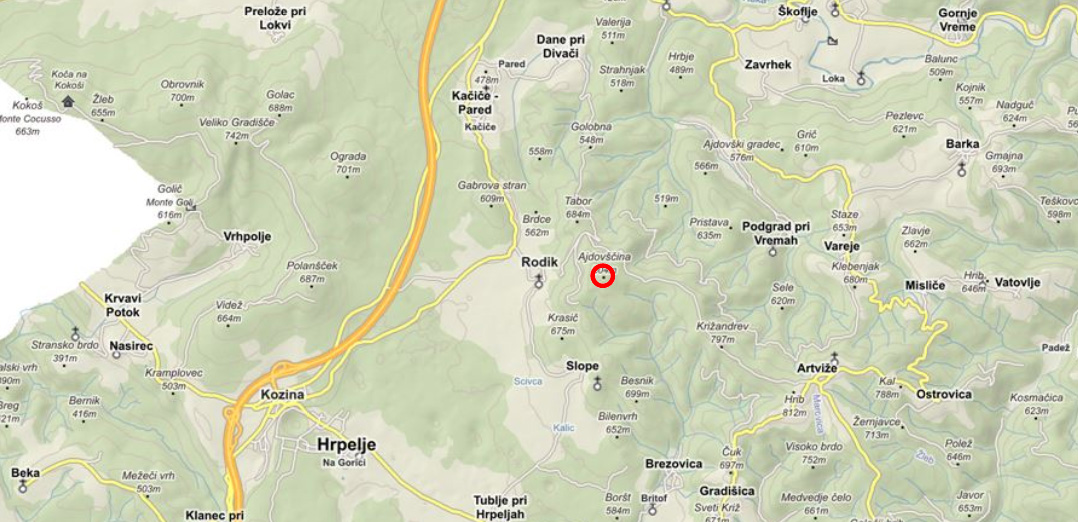
Ajdovščina is a 804m high hill that lies above the village Rodik in the Hrpelje-Kozina municipality. It is an end of the central Brkini ridge of the northern part of Brkini. Hill Ajdovščina has a very exposed and dominant position in the landscape. From it you can see far to Karst region, Vremščica hill, on the crest of Slavnik ridge and the Gulf of Trieste.


Location of hill Ajdovščina on a map (geoprostor.net)
The name of the hill Ajdovščina is interesting. It is derived from the word or name Ajd. Ajdi within the folk tradition usually describe giants or non-Christians. Word came in the Slovenian language from the Middle High German, who has origin in the Germanic base that is derived from the Greek "tàéthnē". In Germanic tales the name of Ajd within the folk tradition and place names have the same meaning as in Slovenian.

In archeology everything connected with Ajdi (placenames, folk traditions) are very important as an indicator of possible archaeological sites. To these giants folk tradition usually attribute origin or construction of larger visible and large structures in landscape, whether human made (hillforts) or natural (rocky walls).

In folk tradition Ajdi
are referenced to the people who were "here" in the landscape before new settlers (Slavs) who are the carriers of giants Ajdi folk tradition.

On the hill Ajdovščina are still visible remains of massive walls, with gates and ruins the walls of individual houses. In the 80s and 90s the hillfort Ajdovščina was investigated by the Department of Archaeology of the Faculty of Arts in Ljubljana. They have conducted some surveys, small scale excavations and geophysical surveys.

Entrance to the hillfort Ajdovščina. On left and right are clearly visible the remains of Late Antiquity wall (photo: Jošt Hobič). 
LiDAR picture of hillfort Ajdovščina. Most of visible archaeological features are from Late Antiquity (author: Jošt Hobič).

Oldest evidence of settlement on Ajdovščina is from early Iron Age (7th century BC). During excavation inside hillfort Ajdovščina they found fragments of pottery and cremation urn grave near road that leads to hillfort from early Iron age. Settlement of hillfort is likely to continue to the Roman period. For now we have evidence that hillfort was still occupied from 1st century BC to the 2nd century AD. Archaeologist found Roman pottery at the top area of hillfort. They were situated under a floor of late antique apse building. Outside the settlements they have discovered two cemetery’s where they excavated 19 graves all dated to Antiquity. After this period settlement is abandoned and possibly inhabitants relocate to of the valley.

One of the visible ruins of Late Antiquity house (photo: Jošt Hobič).
Same house remains with lines of walls drawn (photo: Jošt Hobič).
LiDAR map with location of house. Click to see it better (author: Jošt Hobič).
The hillfort Ajdovščina again comes to life in the turbulent times of Late Antiquity of 4th and 5th century AD. All ruins of drystone walls within the settlements and the wall around settlement, which can still be seen on the surface are from this period.

During
Late Antiquity they strengthen the walls and gates and set the houses that are aligned in a street system and along the wall.
 

At the top of the hill during the excavations archaeologist found a building with an apse. Such a semicircular completion of the building, usually in Late Antiquity hillfort settlements indicates the early Christian church. But here on the basis of the findings such church could not be confirmed yet.

In
Late Antiquity, Ajdovščina, due to the dominant position and close proximity to the Roman state road Aquileia - Tharsatica running through Matarsko valley, acted as control of these road connections to Italy. Therefore we can expect it had permanent military garrison.

For the period of the
Early Middle Ages (from 7th to 9th century AD) and Slavic settlement Ajdovščina was one of the centers in the surrounding area of Romanized indigenous people who still lived here. Despite the absence of archaeological finds, this is assumed on the basis of the interpretative model of the folk tradition and some historical writen evidences.


Literature
Hrobat, K. 2003, Šembilja na rimskih cestah. O ustnem izročilu in arheoloških raziskavah, diplomsko delo, oddelek za arheologijo FF, Ljubljana.

Pavlin, P. 2014, Ajdovščina nad Rodikom, v: Kras in Brkini za radovedneže in ljubitelje, ur. Fakin Bajec J. In Luthar O., ZRC SAZU, Ljubljan – Nova Gorica.

Mušič, B. 1999, Geophysical prospecting in Slovenia: an overwiev with some observations related to natural enviroment, Arheološki vestnik 50, 349-405. Link to article (its in English)